By Our Reporter | Saturday, May 9, 2026
Teachers recruited under Kenya’s now-contested internship programme have intensified their campaign for full employment on permanent and pensionable terms, keeping pressure on the government days after the Supreme Court temporarily shielded the Teachers Service Commission from being compelled to act on a landmark appellate ruling.
This Content Is Only For Subscribers
The push comes in the wake of a February 27, 2026 Court of Appeal judgment that upheld findings of the Employment and Labour Relations Court that teachers hired as interns were in fact employees and had been unfairly treated, with the court finding that designating the teachers as interns was “obviously designed to escape the inescapable effect of the employment relationship and legal safeguards.”
How the Internship Programme Began

The Teachers Service Commission introduced the internship programme as part of a strategy to address teacher shortages while managing fiscal constraints. Under the programme, qualified teachers were hired as interns for a fixed period before possible absorption into permanent positions. In 2023, TSC advertised over 35,000 teaching opportunities, including more than 21,000 junior secondary school internship positions alongside permanent and pensionable posts.
President William Ruto had directed that the interns serve a maximum of two years on contract, earning a Sh20,000 monthly stipend, with a promise of eventual absorption. That promise has not materialised — none of the over 44,000 affected teachers have been confirmed into permanent employment, and their contracts have been extended repeatedly.
Supreme Court Pumps the Brakes
Despite the appellate court’s ruling in the teachers’ favour, the legal battle is far from over. Chief Justice Martha Koome and five other Supreme Court judges issued an order on April 30, 2026, granting the TSC interim stay orders, thereby stopping the execution of the Court of Appeal’s February 27 ruling, which deemed the contracts illegal and invalidated the internship programme.
TSC Acting CEO Evelyn Mitei stated that the sudden termination of the programme, as initially directed by the Court of Appeal, would have been extremely disruptive and detrimental to the interests of more than two million Junior School students, particularly given that no budget had been allocated for the immediate, permanent employment of the teacher interns.
Teachers Take to the Streets
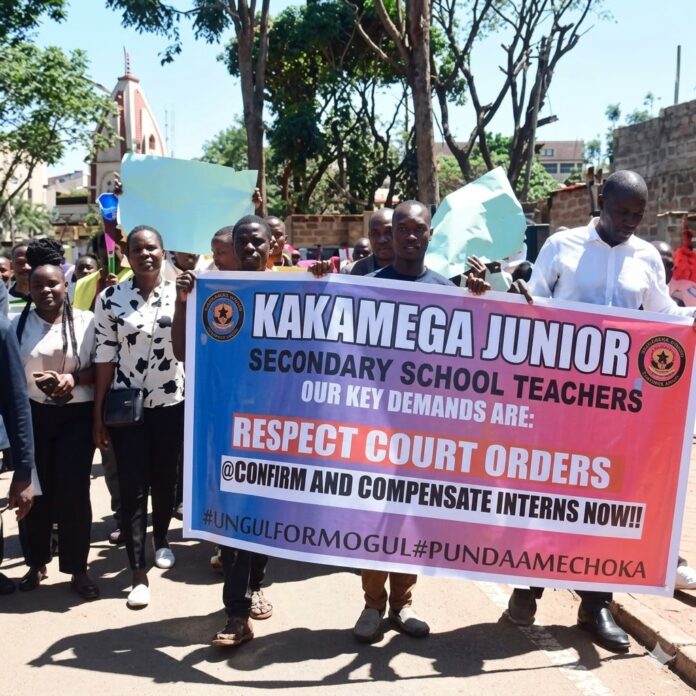
The Supreme Court stay order has done little to dampen the resolve of the intern teachers. On Friday, educators in Vihiga County marched to the TSC sub-county offices in Mbale Town, where they presented a formal petition outlining two core demands.
“We have two prayers in our petition — one is for the Treasury Cabinet Secretary to set aside Sh15 billion in the upcoming budget to facilitate the confirmation of interns, and the second is asking TSC to begin preparing employment files for all interns in readiness for that confirmation,” said Kuppet Vihiga Secretary General Charles Otiende.
The teachers are particularly aggrieved by their take-home pay. After statutory deductions, the Sh20,000 monthly stipend shrinks to approximately Sh17,000 — an amount they say is inadequate given that they carry the same teaching responsibilities as their fully employed counterparts but without access to employment benefits such as medical cover, pension contributions, or housing allowances.
Union Backing Despite Membership Gap
KUPPET Secretary General Akelo Misori has emphasised that the ruling renders the employment status of intern teachers legally untenable, leaving them without a clear framework to govern their engagement. The union has been advocating on the interns’ behalf even though the teachers technically do not qualify for union membership, since they are not recognised as permanent employees under the law.
KUPPET national chairman Omboko Milemba has urged the TSC to seek funds from Parliament and immediately employ the 44,000 junior school intern teachers on permanent and pensionable terms.
TSC Claims It Is Working on It
In a statement dated April 29, TSC announced plans to implement the court ruling, saying it is actively pursuing the necessary budgetary provisions to facilitate the transition of the 44,000 serving teacher interns to permanent, pensionable employment within the public teaching service. However, teachers say they have heard such assurances before and are unwilling to stand down until concrete budget commitments are made.
“We are not offering charity. We report to work, deliver our lessons and expect to be paid fairly and confirmed in our positions,” one teacher told a gathering during Friday’s march.
The standoff continues as the Supreme Court prepares to hear and determine the TSC’s appeal — a ruling that will likely define the future of teacher recruitment policy in Kenya and the fate of tens of thousands of educators currently in legal limbo.